
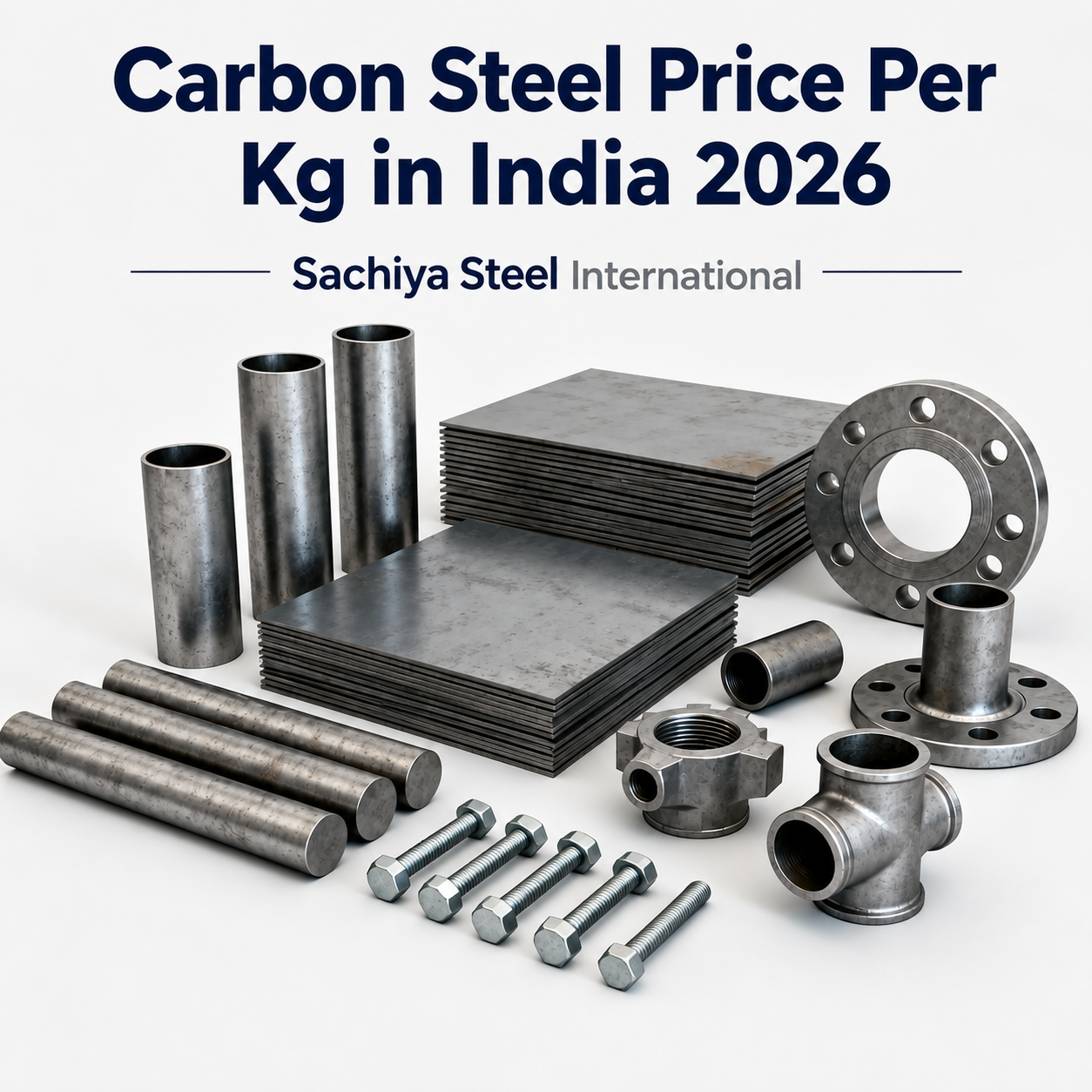
Carbon Steel Price Per Kg in India 2026: Latest Rates, Market Trends & Complete Buying Guide
The carbon steel price per kg in India 2026 is influenced by raw-material costs, domestic demand, manufacturing expenses, transportation, import competition, government policies and global steel-market conditions. Carbon steel continues to be one of the most widely used engineering materials in India because it combines strength, machinability, durability and comparatively competitive pricing.
For buyers, contractors, manufacturers, and EPC companies, checking the carbon steel price per kg in India 2026 before placing a bulk order is important because prices can change according to grade, dimensions, surface finish, manufacturing method, quantity and delivery location.
India’s steel industry entered 2026 with strong domestic demand. Government data shows that crude steel production reached 42.1 million tonnes during April–June 2026, up 3.0% from the corresponding period of 2025, while finished steel production reached 41.0 million tonnes. Finished steel consumption also remained strong, supported by construction, infrastructure and manufacturing.
This updated guide explains the carbon steel price per kg in India 2026, indicative product-wise rates, city-wise market differences, pricing factors, import duties, market outlook and procurement considerations.
Carbon Steel Price Per Kg in India 2026
As of August 2026, indicative carbon steel prices in India vary considerably by product and specification. Buyers should treat the following ranges as market-reference figures rather than fixed quotations because actual prices depend on grade, size, quantity, GST, freight, mill source and delivery terms.
Carbon Steel Price List Per Kg in India 2026
| Carbon Steel Product | Grade / Specification | Indicative Price Per Kg | Approx. Price Per Tonne |
|---|---|---|---|
| Carbon Steel Pipe | ASTM A106 Gr. B | ₹65–₹82 | ₹65,000–₹82,000 |
| Carbon Steel Tube | IS 1239 Medium | ₹62–₹80 | ₹62,000–₹80,000 |
| Carbon Steel Sheet | ASTM A36 | ₹58–₹72 | ₹58,000–₹72,000 |
| Carbon Steel Plate | IS 2062 E250 | ₹59–₹75 | ₹59,000–₹75,000 |
| Carbon Steel Round Bar | EN8 / EN9 | ₹55–₹72 | ₹55,000–₹72,000 |
| Carbon Steel Flange | ASTM A105 | ₹90–₹130 | ₹90,000–₹1,30,000 |
| Carbon Steel Fittings | ASTM A234 WPB | ₹82–₹110 | ₹82,000–₹1,10,000 |
| Carbon Steel Fasteners | IS 1367 | ₹95–₹145 | ₹95,000–₹1,45,000 |
| Hot Rolled Coil | IS 2062 / equivalent | ₹69–₹73 | ₹69,000–₹73,000 |
| Cold Rolled Coil | Commercial Grade | ₹76–₹82 | ₹76,000–₹82,000 |
| TMT Bar | Fe 500 / Fe 500D | ₹55–₹65 | ₹55,000–₹65,000 |
Important: These are indicative 2026 market ranges for SEO and market-reference purposes. Final supplier quotations may differ according to quantity, grade, thickness, dimensions, brand, GST, freight, testing and delivery location.
For comparison, India’s Ministry of Steel reported a July 2026 average price of approximately ₹56,698/tonne for 10 mm TMT, ₹69,828/tonne for 2 mm HR coil and ₹76,583/tonne for 0.63 mm CR coil.
An August 2026 market reference for IS 2062 E250 HRC showed approximately ₹56,500/tonne ex-stockyard in Delhi and ₹57,900/tonne ex-stockyard in Mumbai for 2.5–8 mm material.
What Is Carbon Steel?
Carbon steel is an iron-based alloy in which carbon is the principal alloying element. Its mechanical properties can be modified through carbon content, heat treatment and manufacturing processes.
Carbon steel is commonly selected because it offers:
- High tensile strength
- Good structural performance
- Excellent machinability in suitable grades
- Good weldability in low-carbon grades
- Cost-effective material options
- Wide availability
- Compatibility with numerous industrial manufacturing processes
Common carbon steel categories include low-carbon steel, medium-carbon steel and high-carbon steel.
Low Carbon Steel
Low-carbon steel generally contains a relatively low percentage of carbon and is known for good ductility, weldability and formability. It is frequently used for sheets, structural components, pipes and fabricated products.
Medium Carbon Steel
Medium-carbon grades offer a balance between strength, hardness and ductility. They are commonly used for shafts, gears, machinery components, axles and engineering applications.
High Carbon Steel
High-carbon steel offers greater hardness and wear resistance but generally has lower ductility and weldability. It is used for applications such as springs, cutting tools and high-wear components.
Why Carbon Steel Is Widely Used in India
Carbon steel is an important material for India’s construction, manufacturing, infrastructure and energy sectors. Demand is supported by highways, bridges, buildings, industrial plants, railways, pipelines, power projects and engineering industries.
India’s steel sector continues to expand. Government data indicates that India’s crude steelmaking capacity was approximately 220 MTPA in FY 2025–26, with the industry continuing toward the National Steel Policy objective of 300 MTPA capacity by 2030–31.
This sustained industrial activity directly influences the carbon steel price per kg in India 2026.
Carbon Steel Market Price Trends in 2026
The Indian steel market has shown a combination of strong demand and price pressure during 2026.
Government figures for June and July show that TMT prices moderated from ₹63,893/tonne in April 2026 to ₹56,698/tonne in July. At the same time, HR and CR coil prices remained considerably higher, with July averages of ₹69,828/tonne and ₹76,583/tonne respectively.
This illustrates why there is no single carbon steel price per kg in India 2026. The rate depends heavily on the product category and specification.
For example:
- TMT prices can be lower than engineered carbon steel products.
- HR coils are influenced by flat-steel demand.
- CR coils command a premium because of additional processing.
- Seamless carbon steel pipes generally cost more than basic structural products.
- Forged flanges and fittings carry additional manufacturing costs.
- Precision and heat-treated products can have significantly higher prices.
Carbon Steel Price Per Kg in Major Indian Cities
Steel prices differ between Indian cities because of freight, local inventory, regional demand, dealer margins and proximity to major steel-producing centers.
| City | Indicative HRC Price/Kg | Indicative TMT Price/Kg | Indicative Carbon Steel Sheet Price/Kg |
| Mumbai | ₹57–₹62 | ₹56–₹62 | ₹58–₹72 |
| Delhi | ₹56–₹61 | ₹55–₹61 | ₹57–₹71 |
| Kolkata | ₹55–₹60 | ₹54–₹60 | ₹56–₹70 |
| Chennai | ₹57–₹63 | ₹56–₹63 | ₹58–₹73 |
| Hyderabad | ₹56–₹61 | ₹55–₹61 | ₹57–₹71 |
| Ahmedabad | ₹56–₹61 | ₹55–₹61 | ₹57–₹71 |
| Pune | ₹57–₹63 | ₹56–₹63 | ₹58–₹73 |
| Bengaluru | ₹58–₹64 | ₹57–₹64 | ₹59–₹74 |
These city ranges are indicative and should not be treated as firm delivered quotations. Freight, GST, order volume and stock availability can change the final landed price.
Main Factors Affecting Carbon Steel Price Per Kg in India 2026
Several factors influence the carbon steel price per kg in India 2026.
1. Iron Ore Prices
Iron ore is one of the most important raw materials for integrated steel production. Changes in iron ore prices can influence steelmaking costs and ultimately affect finished carbon steel prices.
2. Coking Coal Prices
Coking coal is particularly important for blast-furnace steel production. In August 2026, Indian steelmakers were facing margin pressure because global coking coal prices had increased. India imports a very large share of its coking coal requirements, making international coal prices and freight costs important factors for domestic steel costs.
3. Scrap Prices
Electric arc furnaces and induction furnaces use significant quantities of steel scrap. When scrap prices rise, production costs for certain carbon steel products can increase.
4. Energy Costs
Steel production requires substantial energy. Electricity, natural gas, fuel and other energy costs can affect manufacturing expenses.
5. Domestic Steel Demand
Infrastructure construction, residential development, industrial expansion, automotive manufacturing and engineering projects can increase steel demand.
India’s finished steel consumption continued to grow strongly during 2026. During April–May 2026, finished steel consumption increased 8.7% year-on-year, according to the Ministry of Steel.
6. Import Competition
Imported steel can influence domestic prices by changing supply availability and competitive pressure.
India became a net importer of finished steel during April–May 2026, with imports of 1.37 million tonnes compared with exports of 0.98 million tonnes.
7. Government Policies
Import duties, safeguard measures, customs policies and trade regulations can affect the landed cost of imported steel and therefore influence domestic market prices.
India introduced safeguard measures on certain non-alloy and alloy steel flat products following concerns about increased imports.
8. Transportation and Freight
The final price paid by a buyer can be higher than the mill or stockyard price because of transportation, loading, unloading, insurance and handling charges.
9. Grade and Specification
ASTM, ASME, EN and IS grades may have different manufacturing and testing requirements. Specialized grades can therefore command higher prices.
10. Quantity Ordered
Bulk orders generally provide better negotiating opportunities than small quantities. Large projects may receive project-specific quotations based on volume and delivery schedules.
Carbon Steel Product-Wise Pricing
Carbon Steel Pipes
Carbon steel pipes are widely used in oil and gas, water transmission, structural applications, process plants and industrial systems.
ASTM A106 Gr. B seamless pipe, ASTM A53 pipe and other carbon steel pipe grades may have different prices depending on diameter, wall thickness, manufacturing method and testing requirements.
The indicative carbon steel price per kg in India 2026 for industrial carbon steel pipes can range from approximately ₹65 to ₹82/kg for commonly traded specifications, while specialized seamless sizes can be higher.
Carbon Steel Tubes
Carbon steel tubes are used for structural, mechanical and fluid-service applications. IS 1239, ASTM A500 and other specifications are available for different applications.
Prices depend on tube diameter, thickness, grade, finish and whether the product is welded or seamless.
Carbon Steel Sheets
Carbon steel sheets are used in fabrication, automotive components, industrial equipment, storage tanks and general engineering.
ASTM A36 and equivalent grades are among the commonly referenced specifications. Sheet thickness, width, surface condition and processing requirements influence the final price.
Carbon Steel Plates
Carbon steel plates are extensively used in pressure vessels, structural fabrication, bridges, machinery, tanks and industrial plants.
IS 2062 grades are widely used in India, while ASTM A36 and other international specifications are also common.
Carbon Steel Round Bars
Round bars are used in shafts, fasteners, machined components, engineering equipment and automotive applications.
EN8 and EN9 are commonly recognized engineering steel grades. The carbon steel price per kg in India 2026 for round bars varies according to diameter, grade, heat treatment and quantity.
Carbon Steel Flanges
Carbon steel flanges are used to connect pipes, valves and equipment. ASTM A105 is a commonly specified forged carbon steel material for industrial flanges.
Flange prices are generally higher per kilogram than basic steel products because of forging, machining, dimensions, testing and finishing requirements.
Carbon Steel Fittings
ASTM A234 WPB fittings are widely used in piping systems. Elbows, tees, reducers, caps and other fittings are manufactured in different schedules and dimensions.
The price depends on fitting type, size, wall thickness, schedule and standard.
Carbon Steel Fasteners
Bolts, nuts, studs and other carbon steel fasteners are used throughout construction and industrial manufacturing.
Fastener pricing is affected by grade, diameter, thread specification, coating, heat treatment and certification requirements.
Carbon Steel Grades Commonly Used in India
Some commonly encountered carbon and low-alloy structural or engineering grades include:
- ASTM A36
- ASTM A53
- ASTM A106
- ASTM A105
- ASTM A234 WPB
- IS 2062
- IS 1239
- EN8
- EN9
- Fe 250
- Fe 415
- Fe 500
- Fe 500D
- Fe 550
Each grade is designed for particular mechanical and service requirements. Buyers should always confirm the applicable specification before comparing prices.
Carbon Steel vs Stainless Steel
Carbon steel and stainless steel serve different applications.
Carbon steel generally provides an economical combination of strength and machinability, while stainless steel is preferred where corrosion resistance is a major requirement.
| Feature | Carbon Steel | Stainless Steel |
| Main composition | Iron + carbon | Iron + chromium and other alloying elements |
| Corrosion resistance | Generally lower | Generally higher |
| Price | Usually lower | Usually higher |
| Strength | High in many grades | High depending on grade |
| Weldability | Depends on carbon content | Depends on grade |
| Common uses | Construction, machinery, pipelines | Food, chemical, pharmaceutical, marine |
| Maintenance | May require protective coating | Often lower corrosion-related maintenance |
The appropriate material should therefore be selected according to service conditions rather than price alone.
Carbon Steel Price Forecast for 2026 and Beyond
The outlook for India’s steel market remains comparatively positive because infrastructure spending, industrial investment and manufacturing activity are supporting demand.
The World Steel Association’s 2026 outlook cited by India’s Ministry of Steel forecasts global steel demand growth of approximately 0.3% in 2026, while India’s steel demand is expected to grow considerably faster.
Industry data published by JSW Steel based on World Steel Association figures forecasts Indian finished steel demand at approximately 171.6 million tonnes in 2026, representing 7.4% growth.
However, prices may remain volatile because of:
- Coking coal price movements
- Iron ore and scrap prices
- Global steel production
- Chinese steel exports
- Indian import volumes
- Currency movements
- Freight costs
- Geopolitical developments
- Domestic infrastructure demand
- Government trade measures
Therefore, buyers should avoid assuming that the carbon steel price per kg in India 2026 will remain constant throughout the year.
Carbon Steel Import and Export Market in India
India is an important global steel producer and exporter, but domestic trade conditions can change rapidly.
During April–June 2026, India’s steel production remained on a growth trajectory. At the same time, higher imports created additional competitive pressure in the domestic market.
Government trade measures are therefore an important consideration when evaluating the carbon steel price per kg in India 2026.
For exporters, international freight, destination-country duties, currency exchange rates, certification requirements and buyer specifications can influence the final export price.
How to Get the Best Carbon Steel Price in India
Businesses purchasing carbon steel in bulk can use several strategies to control procurement costs.
Compare Multiple Suppliers
Obtain quotations from several established suppliers before making a purchase.
Specify the Exact Grade
Do not compare prices without confirming the grade, standard, dimensions and manufacturing process.
Consider Total Landed Cost
The cheapest ex-stock price may not provide the lowest final cost after freight, GST, loading and handling.
Purchase in Bulk
Large-volume orders can provide better commercial terms and reduce repeated logistics costs.
Confirm Quality Documentation
For industrial applications, request relevant documents such as:
- Material Test Certificate
- Chemical composition report
- Mechanical test results
- Dimensional inspection report
- Heat number / traceability details
- Third-party inspection documents where required
Monitor Market Prices
Tracking HRC, TMT, scrap, iron ore and coking coal trends can help buyers choose the right purchasing window.
Why Choose Sachiya Steel International for Carbon Steel Products?
Sachiya Steel International Private Limited supplies a broad range of carbon steel products for industrial, construction and engineering applications.
The product range can include:
- Carbon steel pipes
- Carbon steel tubes
- Carbon steel fittings
- Carbon steel flanges
- Carbon steel fasteners
- Carbon steel round bars
- Carbon steel sheets
- Carbon steel plates
- Carbon steel coils
- Industrial carbon steel components
The company supports customers requiring products manufactured or supplied according to applicable ASTM, ASME, EN and other international specifications.
For project procurement, buyers can discuss grade, size, quantity, testing requirements, documentation, packaging and delivery requirements before requesting a commercial quotation.
Carbon Steel Applications
Carbon steel is used across a wide range of industries, including:
Construction
Used in structural frames, reinforcement, bridges, buildings, warehouses and infrastructure projects.
Oil and Gas
Used in pipelines, process piping, structural components and supporting systems.
Petrochemical
Used in piping systems, tanks, fabrication and plant construction.
Power Generation
Used in boilers, structural components, piping and industrial equipment.
Automotive
Used for components, structural parts, shafts, gears and engineering applications.
Manufacturing
Used for machinery, fabricated structures, equipment and general engineering.
Water and Infrastructure
Used in transmission systems, structural projects and utility applications.
Frequently Asked Questions About Carbon Steel Price Per Kg in India 2026
What is the carbon steel price per kg in India 2026?
The carbon steel price per kg in India 2026 varies according to product, grade and location. Indicative market ranges can start around ₹55–₹65/kg for some common carbon steel products, while pipes, fittings, flanges and specialized engineering products can be significantly higher.
What is the price of carbon steel pipe per kg in India?
Common carbon steel pipe prices can range approximately from ₹65 to ₹82/kg for selected specifications. Seamless, heavy-wall and specialized grades may cost more.
What is the price of carbon steel sheet per kg in India?
Indicative carbon steel sheet prices can range from approximately ₹58 to ₹72/kg, depending on grade, thickness, size, finish and quantity.
What is the price of carbon steel plate per kg?
Common IS 2062 and equivalent carbon steel plates may be available around ₹59–₹75/kg on an indicative basis. Actual prices depend on thickness, dimensions, grade, testing and delivery.
Why does carbon steel price change frequently?
Prices change because of raw-material costs, steel demand, production levels, imports, government policies, energy prices, freight and global market conditions.
Is carbon steel cheaper than stainless steel?
Generally, carbon steel is less expensive than stainless steel because stainless steel contains significant quantities of alloying elements such as chromium and, depending on grade, nickel and molybdenum.
Which factors should I check before buying carbon steel?
Check the material grade, applicable standard, dimensions, quantity, manufacturing method, MTC requirements, inspection requirements, GST, freight and delivery schedule.
Will carbon steel prices increase in 2026?
Prices can move in either direction. India's strong steel demand supports the market, but raw-material costs, imports, global production and geopolitical conditions can create volatility. Current market data should be checked before placing a large order.
Carbon Steel Price Per Kg in India 2026: Key Takeaways
The carbon steel price per kg in India 2026 is not a single fixed number. Prices vary by product, grade, size, manufacturing process, quantity, location and market conditions.
Current 2026 data shows strong Indian steel production and consumption, while steel prices across categories have moved differently. TMT prices moderated during the second quarter of 2026, whereas HR and CR coil prices remained comparatively firm.
For buyers, the best approach is to compare the complete landed cost rather than only the quoted price per kilogram. A reliable supplier should also provide appropriate specifications, quality documentation, inspection support and dependable delivery.
Sachiya Steel International Private Limited can support industrial buyers looking for carbon steel pipes, tubes, fittings, flanges, fasteners, plates, sheets, round bars and other carbon steel products for domestic and international requirements.
Conclusion
The Indian carbon steel market continues to play an important role in construction, infrastructure, manufacturing, energy and engineering. In 2026, strong domestic steel consumption and expanding production capacity are supporting long-term demand, while raw-material costs, imports, trade measures and global market volatility continue to influence prices.
For this reason, the carbon steel price per kg in India 2026 should always be checked against the latest grade-specific quotation, quantity, delivery location and commercial terms.
For accurate procurement, buyers should compare suppliers, confirm material specifications, request quality certificates and evaluate freight and taxes before finalizing an order. With the right sourcing strategy, businesses can control material costs while maintaining the quality and reliability required for demanding industrial projects.