
The steel scrap market in India is experiencing unprecedented growth, driven by a structural shift toward electric arc furnace (EAF) steelmaking and India’s commitment to green steel production. As of January 2026, Steel Scrap Price Per Kg range from ₹35-48/kg for mild steel to ₹145-200/kg for premium stainless steel 316 grades, with significant regional variations based on industrial activity and logistics costs. This comprehensive guide examines current pricing across all major categories, explores the economic forces reshaping the market, and provides actionable strategies for both buyers and sellers to maximize value in an increasingly competitive landscape.
Understanding Steel Scrap: More Than Just Recycling
Steel scrap represents far more than discarded metal—it is the backbone of India’s transition toward sustainable steelmaking. Unlike virgin steel production, which requires iron ore extraction, coking coal mining, and energy-intensive smelting, recycled steel reduces carbon emissions by up to 58% per ton produced. This efficiency advantage has transformed scrap from a commodity to a strategic raw material.
What qualifies as steel scrap? The category encompasses structural materials (beams, channels, angles), industrial offcuts (machine parts, manufacturing waste), consumer products reaching end-of-life (automobiles, appliances), and construction demolition debris. The diversity of sources creates a complex grading system where purity, contamination, density, and composition directly determine market value.
The Indian steel industry generates approximately 25 million tonnes of scrap annually, yet imports reached 3.48 million tonnes in January-April 2025 alone, signaling a structural supply deficit. This gap—expected to widen to 20-30 million tonnes annually by 2030—creates a seller’s market for quality scrap materials.
Current Steel Scrap Prices Per Kg: Complete Market Overview
General Price Range by Scrap Type (January 2026)
| Scrap Category | Price Per Kg (₹) | Price Per Tonne (₹) | Key Characteristics |
|---|---|---|---|
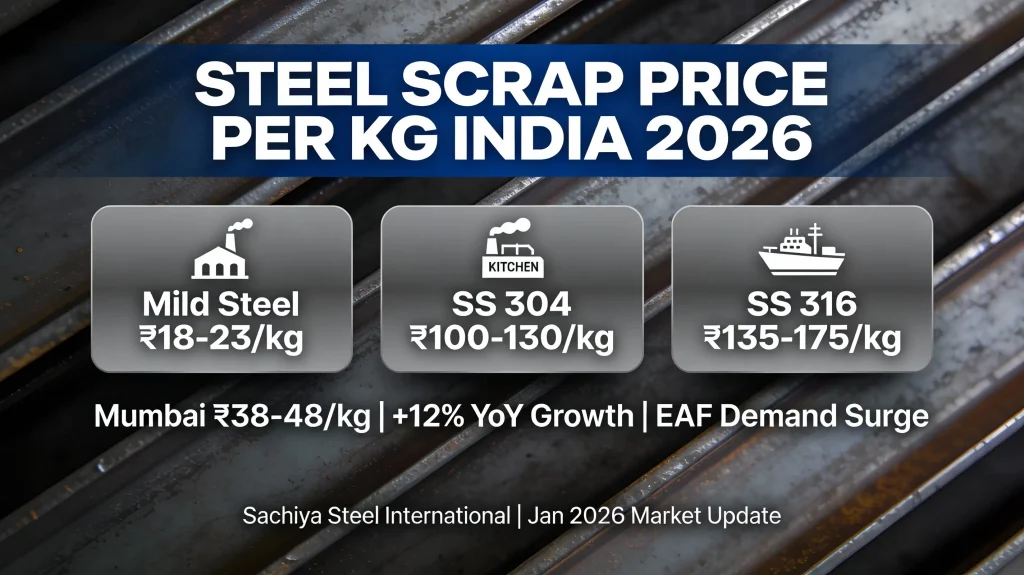
| Mild Steel (General) | ₹18-23 | ₹18,000-23,000 | Most common, lower value, abundant supply |
| Iron Scrap (Mixed) | ₹32-45 | ₹32,000-45,000 | Household & fabrication waste, variable purity |
| Steel Scrap (Industrial) | ₹35-48 | ₹35,000-48,000 | Better purity than mixed iron, regular demand |
| HMS (Heavy Melting Scrap) | ₹34-50 | ₹34,000-50,000 | High-density, superior melting yield, premium pricing |
| Cast Iron Scrap | ₹38-52 | ₹38,000-52,000 | Industrial/foundry sources, dense material |
| Stainless Steel 304 | ₹100-130 | ₹100,000-130,000 | Food/kitchen applications, stable demand |
| Stainless Steel 316 | ₹135-175 | ₹135,000-175,000 | Marine/chemical applications, premium value |
| Tool Steel Scrap | ₹20-26 | ₹20,000-26,000 | Limited availability, specialized use |
| Alloy Steel Scrap | ₹95-110 | ₹95,000-110,000 | Loose form, excellent melting properties |
| Alloy Casting Scrap | ₹430-470 | ₹430,000-470,000 | Highest value, limited availability |
Important Note: Prices listed exclude GST (18%), freight, packaging, and other ancillary charges. Actual realization depends on location, buyer type, transaction volume, and current market conditions.
State-by-State Steel Scrap Pricing Analysis
Regional price variations reflect industrial density, furnace demand, transportation infrastructure, and local market competition. Understanding your region’s pricing benchmark is essential for negotiating fair rates.
Metropolitan Hub Pricing (January 2026)
| State/City | Mild Steel (₹/kg) | Iron Scrap (₹/kg) | SS 304 (₹/kg) | SS 316 (₹/kg) | Market Characteristics |
|---|---|---|---|---|---|
| Maharashtra (Mumbai) | ₹38-48 | ₹40-55 | ₹95-120 | ₹160-210 | Port access, automotive demand, competing buyers |
| Delhi NCR | ₹35-45 | ₹38-52 | ₹90-115 | ₹150-200 | High population, dense industrial zones, aggressive pricing |
| Gujarat (Ahmedabad) | ₹35-46 | ₹39-55 | ₹92-118 | ₹155-205 | Port city advantage, strong foundries, exporters |
| Tamil Nadu (Chennai) | ₹34-44 | ₹38-50 | ₹85-110 | ₹145-195 | Automotive clusters, coastal logistics |
| Karnataka (Bangalore) | ₹33-45 | ₹40-53 | ₹90-115 | ₹150-200 | IT waste, premium SS demand, limited competition |
| West Bengal (Kolkata) | ₹32-43 | ₹35-48 | ₹88-110 | ₹145-190 | Industrial base, lower logistics costs |
| Punjab (Chandigarh) | ₹36-48 | ₹40-52 | ₹92-118 | ₹155-200 | Small industrial units, better-paying buyers |
Market Insight: Mumbai and Ahmedabad typically command 5-10% price premiums due to port access and export logistics advantages. Smaller cities often offer 10-15% lower rates due to transportation friction and limited buyer competition.
What Drives Steel Scrap Prices? Seven Critical Factors
Understanding pricing mechanics allows sellers to time sales strategically and buyers to predict cost trends. The steel scrap market responds to multiple interconnected variables that create daily price fluctuations.
1. Global Economic Activity and Steel Demand
Steel scrap pricing is fundamentally tied to global manufacturing output. When major economies experience growth—China’s infrastructure expansion, U.S. construction recovery, or European automotive manufacturing—global steel demand rises, pulling scrap prices upward. Conversely, economic contractions (2008 financial crisis, 2020 pandemic) triggered scrap price collapses of 40-50%.
Current Dynamics: India’s crude steel production crossed 140 million tonnes in 2024, with government targets of 300 million tonnes by 2030. This aggressive expansion drives consistent scrap demand, supporting relatively stable pricing despite global headwinds.
2. The Green Steel Revolution: EAF vs. Blast Furnace Economics
India’s shift toward Electric Arc Furnace (EAF) steelmaking represents the most significant structural change to scrap markets in decades. Traditional Blast Furnace (BF) mills produce 80% of India’s steel but require iron ore and coking coal. EAF mills rely entirely on scrap and electricity—and produce 58% lower carbon emissions.
The Structural Opportunity: India’s crude steel capacity is expected to reach 300 million tonnes by 2030, with EAF’s share rising from 15% to 50%. This shift alone could increase scrap demand by 65+ million tonnes annually. The resulting 20-30 million tonne annual import gap means scrap supply will remain constrained for the next 5-7 years, supporting price stability and upside potential.
Seller Implication: Quality scrap commands premium pricing precisely because EAF mills require high-purity material to maintain product specifications. Contaminated scrap faces rejection or significant haircuts.
3. Direct Reduced Iron (DRI) Competition
While EAF mills prefer scrap, they accept domestically produced Direct Reduced Iron (sponge iron) as an alternative when prices favor it. When DRI prices fall sharply, Indian induction furnace mills substitute it for scrap, depressing scrap demand temporarily.
Mid-2025 saw DRI prices collapse as Chinese sponge iron flooded Indian markets, causing scrap import volumes to decline 8-12% despite strong crude steel output. This dynamic illustrates pricing volatility driven by metallurgical substitution rather than true supply-demand imbalances.
4. Transportation Costs and Logistics Networks
Fuel prices, shipping rates, and port charges directly compress buyer margins. When crude oil exceeds $80/barrel, transportation costs rise 10-15%, and buyers reduce bids proportionally. Conversely, fuel price declines in Q4 2023-Q1 2024 supported modest price recovery despite global uncertainty.
Regional Impact: Cities distant from recycling hubs (Pune, Jaipur, Indore) see 8-12% price discounts due to higher transport costs. Coastal cities (Mumbai, Ahmedabad, Chennai) command premiums due to export logistics.
5. Commodity Market Linkages
Scrap steel prices correlate strongly with international steel commodity pricing. When LME steel futures rise, domestic scrap prices typically follow within 2-3 days. Similarly, critical alloying elements—nickel content in SS 304, molybdenum in SS 316—directly influence stainless steel scrap values.
Monitoring Strategy: Track FastMarkets India ferrous scrap indices and LME steel futures (LMEX) to anticipate price movements 1-2 weeks ahead.
6. Quality Grading and Contamination Impact
Industry standards (BIS IS 2549:2023) define scrap grades: shredded, busheling, HMS, stainless grades 304/316. Quality distinctions create pricing tiers:
-
Premium HMS (clean, high-density): ₹48-52/kg
-
Standard HMS (minor contamination): ₹42-48/kg
-
Lower-grade scrap (rusty, contaminated): ₹32-38/kg
A single batch of poorly sorted scrap can forfeit ₹8-15/kg in value. Conversely, meticulously cleaned, graded material commands ₹2-5/kg premiums.
7. Government Policy and Import-Export Dynamics
India maintains 0% import duty on steel scrap—a deliberate policy to support the industry’s green transition. Export bans in certain countries (Turkey restricted scrap exports in 2023-24) redirect scrap flows to India, improving supply and stabilizing prices.
Vehicle Scrappage Policy (2021) channels 2-3 million vehicle bodies annually through licensed centers, creating a consistent, quality-controlled supply stream that stabilizes market fundamentals.
Steel Scrap Grade Analysis: Why Quality Matters More Than Quantity
Professional scrap sellers understand that grade purity directly translates to buyer willingness-to-pay. The gap between premium and low-quality scrap can exceed 30%, making preparation economics crucial.
Mild Steel and Carbon Steel Grades
Mild Steel (General Industrial) commands ₹18-23/kg because it’s abundant and requires moderate purification. Found in appliances, construction waste, and fabrication offcuts, mild steel requires minimal processing.
HMS (Heavy Melting Scrap) fetches ₹34-50/kg because foundries and EAF mills prize its density and predictable chemistry. Dense, compact pieces melt efficiently, improving furnace yield. Vendors report that HMS exhibits 12-18% superior melting recovery compared to loose mild steel.
Punching Scrap and Cutting Trim realize premiums of ₹45-65/kg precisely because CNC machines generate pure, contamination-free pieces with minimal cleaning requirements. A fabrication shop’s punch scrap commands 2.5x the price of mixed household iron.
Stainless Steel: The Premium Category
SS 304 (₹100-130/kg) contains 18% chromium and 8% nickel, ideal for food contact surfaces and kitchen equipment. Industrial demand remains steady, supporting stable pricing.
SS 316 (₹135-175/kg) adds 2-3% molybdenum for superior corrosion resistance, commanding 35-40% price premiums over 304. Used in marine environments, chemical processing, and pharmaceutical applications where reliability is non-negotiable. Shortage of 316 scrap globally (more 316 material is still in service) supports premium pricing.
Stainless Foundry Scrap (₹120-180/kg) targets specialty casting operations where alloy composition must be precisely controlled. A foundry rejecting contaminated stainless material faces production delays; thus they accept price premiums (₹10-20/kg above commodity rates) for guaranteed quality.
Industrial Specialty Grades
Alloy Steel Scrap (₹95-110/kg) and Alloy Casting Scrap (₹430-470/kg) serve tool steel, bearing steel, and specialty applications. Volumes are limited, creating supply constraints that support elevated pricing. A single shipment of aviation-grade alloy scrap can reach ₹600+/kg—far exceeding commodity levels.
Market Structure: Who Buys Steel Scrap and How It Determines Price
Price discovery in scrap markets depends critically on buyer type. Understanding the hierarchy helps sellers navigate to higher-paying buyers.
Buyer Hierarchy and Price Realization
Primary Steel Mills (Direct): Industry leaders like Tata Steel, JSW Steel, and ArcelorMittal Nippon operate their own purchasing networks. Direct sales to mills eliminate middlemen, offering 5-15% price premiums for volume commitments (100+ tonnes). However, mills impose strict quality specifications (maximum rust levels, contamination thresholds, dimensional limits).
EAF/Induction Furnaces (Secondary Demand): Smaller mills and foundries (50-500 TPD capacity) represent the largest buyer base. They typically pay fair market rates through established dealers, offering flexibility on quality tolerances and accepting smaller lot sizes (1-50 tonnes).
Scrap Dealers/Traders (Intermediaries): Organized dealers aggregate small quantities, sort by grade, and bundle for mill sale. They capture 2-5% margin, meaning sellers receive 95-98% of published rates. Dealer networks dominate in metros, offering convenience but lower per-kg realization.
Online Platforms (Emerging): Scrapwala, Kabadiwala, and similar platforms disrupt traditional channels by connecting sellers directly to verified buyers. Platform economics typically yield 93-97% of published rates after platform commission, improving transparency though creating scheduling complexity for small volumes.
Regional Market Dynamics: Why Your City’s Pricing Matters
High-Demand Clusters
Automotive Hubs (Chennai, Pune, Bangalore): Proximity to vehicle manufacturing and ancillary clusters drives consistent demand for scrap. Body scrap and press offcuts flow continuously, supporting stable, competitive pricing. Sellers report 3-7% price premiums during peak production seasons (Jan-Mar, Oct-Dec).
Port-Linked Cities (Mumbai, Ahmedabad, Visakhapatnam): Export logistics advantage supports premium pricing for export-grade scrap. Foreign buyers seeking consistent supply at volume (1000+ tonnes/month) negotiate directly at port cities, pulling local market prices upward.
Construction-Intensive Cities (Bangalore, Pune, Hyderabad): Redevelopment activity generates demolition scrap continuously. During major construction booms (2022-24 Hyderabad IT expansion), demolition scrap prices spiked 12-18% above national averages.
Lower-Price Markets
Tier-2 Industrial Cities (Ghaziabad, Indore, Nagpur): Limited buyer competition and higher transport friction typically result in 10-15% price discounts versus metros. A seller in Indore receiving ₹38/kg realizes prices metro sellers achieve at ₹44-48/kg.
Rural and Non-Industrial Zones: Scrap collection in non-industrial areas requires aggregation over weeks, attracting dealer networks with monopsony power. Price realization often falls 20-25% below published benchmarks due to buyer information asymmetry.
Seasonal Pricing Patterns: Timing Your Sale
Steel scrap prices exhibit pronounced seasonality reflecting construction activity, manufacturing cycles, and holiday demand patterns.
Q1 (Jan-Mar): Peak Pricing Season
-
Construction resumes post-monsoon and winter
-
Manufacturing ramp-up after holiday shutdowns
-
School/office renovations drive demolition scrap
-
Price Trend: 3-8% above annual average
-
Seller Strategy: Accumulate during Q4 and sell in Jan-Feb window
Q2 (Apr-Jun): Moderate Decline
-
Summer heat reduces construction activity in North India
-
Monsoon approach creates logistics uncertainty
-
Demand remains stable from mill operations
-
Price Trend: Near annual average, slight seasonal weakness
-
Seller Strategy: Regular sales, monitor week-to-week rates
Q3 (Jul-Sep): Seasonal Trough
-
Monsoon disrupts transportation and site work
-
Waterlogging reduces construction material demand
-
Buyer inventory buildup dampens fresh purchases
-
Price Trend: 5-10% below annual average
-
Seller Strategy: Defer sales if possible, accept lower rates only for urgent liquidity
Q4 (Oct-Dec): Recovery Phase
-
Post-monsoon construction revival
-
Year-end budget spending by municipal/government bodies
-
Holiday season manufacturing disruptions reduce collection volume
-
Price Trend: 2-6% above Q3, approaching Q1 levels
-
Seller Strategy: Initiate sales as weather improves
The 2025-2030 Market Outlook: Why Scrap Prices Have Structural Support
Industry analysts and primary steel producers expect persistent scrap pricing strength through 2030, driven by three converging trends:
1. EAF Capacity Explosion: The Largest Growth Driver
India’s crude steel capacity will expand from 200 million tonnes (2024) to 300 million tonnes (2030). Critically, EAF mills will represent 50% of new capacity additions, requiring 65+ million tonnes of annual scrap input by 2030. Domestic scrap generation reaches only 30-35 million tonnes, creating a permanent 20-30 million tonne annual import requirement.
Market Implication: Scrap availability will remain the binding constraint on steel production. Prices will adjust to ration scarce supply among competing mills, supporting baseline price floors 8-12% above 2020-22 historical averages.
2. Green Steel Mandates and ESG Procurement
Global automotive OEMs (Mercedes, BMW, Volkswagen) and appliance makers increasingly require “green steel” meeting carbon footprint thresholds. Only EAF mills achieve the 50%+ CO₂ reduction required. This regulatory pressure guarantees sustained EAF mill investment and scrap demand regardless of commodity price cycles.
Buyer Note: Long-term supply contracts (3-5 year terms) now include green premium clauses, potentially adding 5-8% to scrap prices for certified low-carbon material.
3. Decarbonization Paradox: Increased Scrap Demand from Traditional Mills
Even Blast Furnace mills, which historically used minimal scrap, are now blending 15-25% scrap into their charges to meet carbon targets. This dual demand (EAF + BF mill blending) creates structural oversupply of demand relative to supply—a rare market condition supporting prices.
Maximizing Scrap Value: Preparation Economics
The difference between average and excellent scrap preparation can exceed ₹10-15/kg—often representing 25-35% price upside. The following strategies directly translate to improved realization:
1. Grade Segregation Protocol
Investment: 2-3 hours per 100 kg, minimal equipment
Expected Outcome: 8-15% price improvement
Separate materials by magnetic properties (ferrous vs. non-ferrous) and visual grade (mild steel vs. stainless vs. cast iron). A mixed 100 kg batch averaging ₹40/kg can be divided into:
-
Stainless Steel (15 kg) @ ₹115/kg = ₹1,725
-
Mild Steel (65 kg) @ ₹42/kg = ₹2,730
-
Cast Iron (20 kg) @ ₹48/kg = ₹960
-
Total: ₹5,415 vs. ₹4,000 for undifferentiated scrap (+35% improvement)
2. Contamination Removal
Process: Remove rubber, plastic, wood, and insulation
Investment: 1-2 hours per batch
Expected Outcome: 3-8% price premium
Contaminated scrap faces haircuts or rejection. A 10 kg contamination rate on 100 kg reduces effective weight to 90 kg, destroying margins. Clean scrap attracts buyer premiums consistently.
3. Rust Mitigation and Surface Conditioning
Process: Light grinding, wire brushing, or sandblasting
Investment: 2-4 hours per 100 kg
Expected Outcome: 4-10% price improvement for heavily rusted material
Rust creates two problems: (1) reduced effective weight (rust oxidation mass), and (2) contamination in furnace scrap charge. Buyers accept small surface oxidation but reject heavy rust layers. For outdoor-stored scrap, protective covering during monsoon seasons prevents 5-8% value degradation.
4. Volume Aggregation Economics
Lot Size Impact:
-
5-10 kg batches: 10-15% discount vs. quoted rate
-
50-100 kg batches: 3-5% discount vs. quoted rate
-
500+ kg batches: Par (market rate) or slight premium
-
2000+ tonnes: 2-5% premium for export-grade material
Accumulating scrap over 4-6 weeks to reach 100+ kg minimizes per-unit discounts from small-lot friction.
Buying Steel Scrap: Due Diligence Checklist for MSME Procurement
For manufacturers requiring consistent scrap supply, the procurement process directly impacts cost structure and product quality.
Pre-Purchase Verification
-
Confirm supplier grade certification (BIS IS 2549:2023)
-
Review third-party test reports (chemical composition, impurity levels)
-
Inspect physical samples for contamination, rust, and dimensional consistency
-
Verify supplier’s yard registration and compliance certifications
Contractual Terms
-
Specify maximum allowable impurity levels (sulfur, phosphorus, copper)
-
Define dispute resolution for weight/quality disagreement
-
Establish price adjustment mechanisms for volatile periods
-
Negotiate sampling protocols and testing frequency (per lot or batch)
Logistics Coordination
-
Define loading method (magnet, crane, manual) affecting scrap integrity
-
Clarify freight responsibility and transport equipment specifications
-
Establish contamination prevention measures (covers, segregated vehicles)
-
Confirm delivery schedules and inventory management protocols
Documentation Standards
-
GST invoices under HSN 7204 with 18% tax
-
TCS (Tax Collected at Source) entry at 1% of payment
-
Material Test Certificates (MTC) for alloy grades
-
Weighbridge slips for transaction verification
Real-World Case Studies: Price Realization Across Buyer Types
Case 1: Home Renovator (Household Scrap Seller)
Scenario: Rajesh collected old iron gates, pipes, and rods during home renovation in Bangalore (approximately 120 kg).
Path 1 – Kabadiwala App: Booked collection, driver weighted scrap as mixed iron @ ₹39/kg = ₹4,680. Convenience factor worth 10% discount.
Path 2 – Local Dealer Negotiation: Rajesh sorted stainless utensils (8 kg) separately, presented mixed iron (112 kg). Dealer offered ₹42/kg mild steel + ₹118/kg stainless = ₹4,704 + ₹944 = ₹5,648. (+20% vs. Path 1)
Learning: Even household sellers benefit from 30-minute sorting effort, extracting ₹968 additional value.
Case 2: Fabrication Workshop (Industrial Seller)
Scenario: A small metal workshop in Pune generating 500 kg/month scrap (punching waste, offcuts, rejected components).
Current Practice: Weekly sales to neighborhood dealer @ ₹41/kg average = ₹20,500/month.
Optimization Strategy:
-
Separate stainless from mild steel
-
Accumulate to 1500+ kg for bulk buyer access
-
Target direct mill sales during Q1-Q2 peak seasons
-
Negotiate 6-month supply contracts
Projected Outcome: ₹44-46/kg average × 500 kg = ₹22,000-23,000/month (+10-12%)
Annual Impact: ₹24,000-36,000 additional revenue from sorting and strategic timing alone.
Case 3: Construction Demolition Project (Bulk Seller)
Scenario: Municipal redevelopment project in Delhi yielding 2000 tonnes demolition scrap.
Buyer Selection Impact:
-
Dealer Network: ₹38/kg (₹76 lakhs) – convenient, reliable payment
-
Direct Mill Sale: ₹41-43/kg (₹82-86 lakhs) – requires logistics coordination, 30-60 day contract negotiation
-
Export-Grade Aggregator: ₹44-46/kg (₹88-92 lakhs) – stringent quality requirements, 8-12 week timeline
Selection Factors: Project budget timeline, quality tolerance flexibility, capital availability for delayed payment.
Tools and Resources for Real-Time Price Monitoring
Staying informed on price movements enables tactical selling decisions. Professional scrap dealers monitor multiple sources:
Primary Price References
-
MetalMiner India: Ferrous scrap indices updated daily, regional breakdowns
-
FastMarkets Ferrous Scrap: Industry benchmark for spot and contract pricing
-
LME Steel Futures (LMEX): Global reference for price direction, 1-2 week leading indicator
-
MRAI (Material Recycling Association India): Industry data, supply-demand analysis, policy updates
Secondary Local Sources
-
Scrapwala/Kabadiwala Apps: Real-time local pricing for competitive benchmark
-
WhatsApp Dealer Networks: Immediate local price updates, often 2-3 hours ahead of formal price discovery
-
Industry Group Chats: Peer discussions on market trends, buyer behavior, regional variations
Forecasting Indicators
-
Global Steel Production Index: Leading indicator for demand 1-2 months forward
-
Indian Construction PMI: Demolition scrap supply proxy
-
Crude Oil Prices: Transportation cost influence
-
Currency (USD/INR): Export competitiveness and import parity pricing
Frequently Asked Questions
Q1: What is the current price of steel scrap per kg in India (January 2026)?
A: Current prices range from ₹35-48/kg for general steel scrap to ₹145-200/kg for premium stainless steel 316. Mild steel averages ₹18-23/kg. Prices vary 10-20% by region and 15-30% by grade quality. For current rates, consult FastMarkets India or local dealer quotations.
Q2: Which steel scrap type offers the highest price?
A: Alloy casting scrap commands the highest prices (₹430-470/kg), followed by stainless steel 316 (₹145-175/kg). Limited supply and specialized demand support premium pricing. However, trading volumes are minimal—most transactions involve HMS, stainless 304, and mild steel.
Q3: Why do Mumbai and Ahmedabad prices exceed national averages?
A: Port-linked cities enjoy 5-10% premiums due to export access. When domestic scrap supply tightens, international buyers source from coastal locations, pulling prices upward. Additionally, dense industrial clusters in these cities support competitive buying, which paradoxically supports seller prices through transparency.
Q4: How do I determine fair pricing for my scrap?
A: Cross-reference three sources: (1) FastMarkets India indices, (2) quotations from competing buyers, (3) local app-based benchmarks. Most fair prices fall within 5% of published market rates. Significant discounts (>10%) suggest either quality issues or monopsony buyer power.
Q5: Does rust significantly reduce scrap value?
A: Heavy rust creates two problems: (1) weight reduction (oxidation), and (2) contamination. Light surface oxidation (5-10% rust coverage) incurs 2-3% haircuts. Heavy rust (50%+ surface coverage) triggers 8-15% discounts or outright rejection. Prevention through dry storage is critical.
Q6: Should I sell now or wait for prices to improve?
A: Market timing is secondary to preparation quality. A well-prepared batch sold at current prices often yields more than degraded scrap sold at peak pricing. That said, Q1 (Jan-Mar) and Q4 (Oct-Dec) historically offer 3-8% seasonal premiums. If holding costs are low, deferring 6-8 weeks from Q3 (monsoon) to Q4 typically justifies the wait.
Q7: What is the difference between HMS and mild steel scrap?
A: HMS (Heavy Melting Scrap) exhibits higher density, predictable chemistry, and superior melting yield (12-18% better). Mild steel scrap refers to loose, variable material. HMS commands ₹34-50/kg premiums while mild steel averages ₹18-23/kg. Selection depends on furnace requirements and application.
Q8: Can stainless steel scrap be mixed with mild steel?
A: Strongly avoid mixing stainless and mild steel. Nickel and chromium from stainless contaminate mild steel scrap, creating metallurgical problems in furnace melting. Mixing erases stainless premiums, reducing value by 50-70% for the entire batch. Segregation is mandatory for maximum realization.
Q9: How often do scrap prices change?
A: Spot prices adjust daily based on immediate supply-demand and global market signals. Formal published indices (FastMarkets, MetalMiner) update on 1-2 week cycles to reflect trend changes. Actual dealer quotations fluctuate throughout each week, with tighter spreads Tuesday-Thursday (midweek market peak) and wider spreads Monday/Friday (lighter trading).
Q10: Where can I sell large volumes (500+ tonnes)?
A: Direct mill contact (Tata Steel, JSW, ArcelorMittal) for volumes exceeding 100 tonnes. Export aggregators for 1000+ tonnes seeking overseas-grade material. Dealer networks remain viable but offer 2-5% lower realization. Online platforms (Scrapwala bulk section) serve 50-500 tonne intermediate volumes with transparent pricing.
Strategic Recommendations: Maximizing Value in 2026
For Scrap Sellers
-
Prioritize Grade Segregation: Allocate 2-3 hours per batch for sorting. ROI exceeds 20% for organized sellers.
-
Accumulate to Bulk Thresholds: Target 500+ kg batches to unlock wholesale pricing—typically 5-10% above per-kg rates.
-
Monitor Seasonal Windows: Q1 and Q4 offer 3-8% pricing advantages. Build inventory during slow seasons, liquidate during demand peaks.
-
Establish Buyer Relationships: Direct buyer connections yield 5-15% premiums over dealer intermediation. Invest time building direct mill or EAF operator relationships.
-
Track Quality Investment ROI: Cleaning, rust mitigation, and contamination removal typically yield 5-15% price improvements with minimal investment.
For Scrap Buyers (Mills, Foundries)
-
Diversify Supplier Base: Dependency on single dealers creates monopsony vulnerability. Multi-sourcing (direct dealers, aggregators, online platforms) improves pricing leverage.
-
Lock Long-Term Contracts: 6-12 month supply agreements at negotiated bulk pricing reduce price volatility and secure consistent supply. Budget a 3-5% premium for stability.
-
Implement Quality Specifications: BIS IS 2549:2023 compliance ensures consistent furnace performance. Specify maximum impurity tolerances (sulfur, phosphorus, copper) in contracts.
-
Consider Vertical Integration: High-volume mills (300+ TPD scrap consumption) should explore captive collection to reduce middleman margins by 2-4%.
Conclusion: The Scrap Market’s Structural Transformation
Steel scrap in India is transitioning from a commodity to a strategic raw material—driven by irreversible structural trends: EAF capacity expansion, green steel mandates, and a permanent supply deficit predicted through 2030. Current pricing reflects this fundamental rebalancing, supporting both baseline price stability and periodic upside surprises.
For sellers, the opportunity is clear: quality-prepared scrap commands sustainable premiums, and strategic timing amplifies realization. Modest investments in segregation and contamination removal yield 20-35% returns. For buyers, the imperative is equally stark: scrap supply will remain tight, making long-term relationships and quality partnerships non-negotiable.
Monitor FastMarkets indices weekly. Segregate by grade religiously. Accumulate to 500+ kg batches before selling. Time sales for Q1 or Q4 peaks when demand pressures pull prices upward. The scrap seller or buyer who treats this market as a strategic supply chain problem—not a commodity transaction—will extract disproportionate value throughout the 2026-2030 period.